 Your Ideas OS
Log in to learn from real founders, exchange ideas, and work on businesses that move from concept to execution.
Access Knowasiak
Join the conversations shaping real businesses.


Automotive Engineering Services Market Role in Reducing Time-to-Market 2032
Automotive Engineering Services Market Outlook (2025–2032): Driving Innovation in a Rapidly Evolving Industry
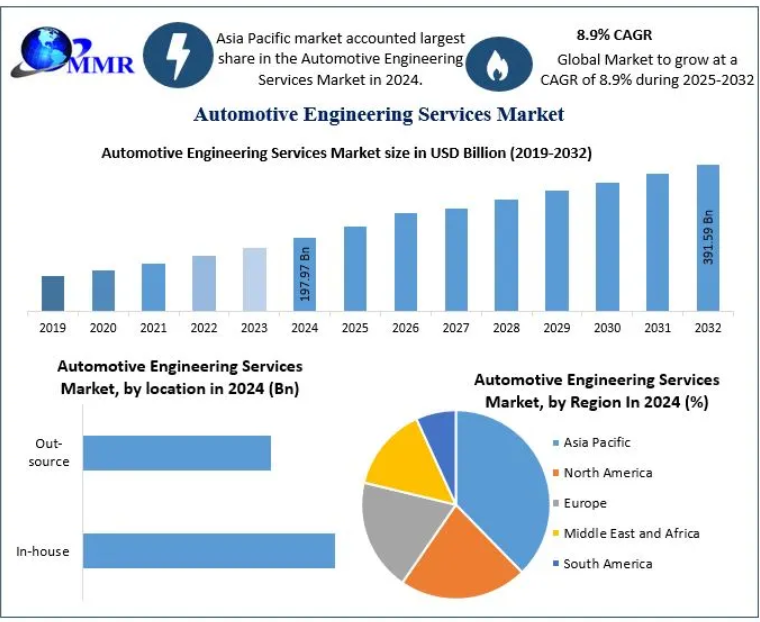
The Automotive Engineering Services Market is experiencing a transformative shift, driven by rapid advancements in vehicle technologies, changing consumer preferences, and a global push toward sustainability. Valued at USD 197.97 billion in 2024, the market is poised to reach USD 391.59 billion by 2032, growing at a CAGR of 8.9% during the forecast period. This growth reflects a rising demand for engineering services that can cater to next-generation mobility solutions, electric vehicles (EVs), and autonomous driving systems.
For in-depth information on this study, visit the following link:https://www.maximizemarketresearch.com/request-sample/32395/
What Are Automotive Engineering Services?
Automotive engineering services encompass a range of support activities provided to original equipment manufacturers (OEMs) and Tier-1 suppliers. These services cover:
Design and prototyping
System integration
Testing and validation
Simulation and modeling
ADAS (Advanced Driver * istance Systems)
Connectivity and software development
Battery and powertrain engineering
They aim to reduce product development cycles, lower costs, and improve innovation outcomes in an increasingly digital and automated automotive environment.
Market Drivers
1. EV Adoption and Green Regulations
As global carbon emission norms tighten, OEMs are investing heavily in electric vehicle (EV) development. Automotive engineering services play a key role in designing, testing, and integrating EV-specific systems, including battery management systems (BMS), electric drivetrains, and charging infrastructure.
2. Surge in Autonomous and Connected Vehicles
The race toward Level 4 and Level 5 autonomy has escalated demand for engineering services that specialize in software development, real-time data processing, radar/lidar integration, and V2X (vehicle-to-everything) communication.
3. Digitalization and 3D Prototyping
The increased adoption of 3D printing and CAD software for rapid prototyping is allowing manufacturers to reduce errors and costs. This digital shift is a major growth enabler for prototyping services within the automotive sector.
4. Outsourcing Trend Among OEMs
Due to increased complexity in vehicle design and the need for faster time-to-market, outsourcing engineering tasks to specialized service providers has become commonplace. This has opened new revenue streams for global engineering service providers.
Market Challenges
Intellectual Property (IP) Restrictions: Engineering service providers working with multiple OEMs face potential IP conflicts, limiting their ability to reuse patented technologies.
Economic Uncertainty: The lingering impact of global economic disruptions, including post-pandemic recovery and inflationary pressure, affects R&D budgets and long-term investments.
Talent Gaps and Infrastructure: Developing economies may face shortages in skilled engineering talent and high-end testing infrastructure, which can restrict market scalability.
Segment Insights
By Service Type
Prototyping dominates the current market, driven by advanced 3D modeling tools and increased demand for digital twins.
Testing is expected to grow fastest (~30% CAGR), as manufacturers invest in real-world simulation environments and high-voltage testing for EV components.
By Location
Outsourced services hold the largest share due to cost advantages and the scalability of third-party providers.
OEMs increasingly rely on external partners for connected vehicle development, cybersecurity, and software updates, aligning with trends in shared mobility and over-the-air updates.
By Application
Connectivity services are set to dominate, as 5G infrastructure expands and enables vehicle-to-vehicle (V2V), vehicle-to-infrastructure (V2I), and V2X communication.
Battery and powertrain services are gaining traction due to EV proliferation.
By Propulsion
While ICE vehicles still command a large portion of the market, electric propulsion is rapidly catching up, particularly in Asia and Europe, due to government incentives and consumer demand.
To access more details regarding this research, visit the following webpage:https://www.maximizemarketresearch.com/request-sample/32395/
Regional Outlook
Asia-Pacific (2024 share: ~42%)
Leads the global market due to high vehicle production, EV adoption, and strong government support in countries like China, India, and Japan.
China’s rapid EV deployment and industrial policy reforms make it a global hub for automotive R&D.
Europe
Home to major OEMs and strict environmental policies, Europe is fostering innovation in green mobility, connected cars, and autonomous driving.
North America
Expected to witness robust growth, driven by technological innovation, autonomous vehicle pilot programs, and government funding for smart transportation systems.
Competitive Landscape
The market is intensely competitive, featuring global players with diversified portfolios in vehicle design, electrification, software integration, and system simulation. Key players include:
Robert Bosch GmbH (Germany)
Bertrandt AG (Germany)
AVL List GmbH (Austria)
HCL Technologies Ltd. (India)
Altran (Capgemini Engineering, France)
Altair Engineering (US)
Ricardo (UK)
EDAG Group (Germany)
These companies are investing in innovation centers, IP protection frameworks, and AI-driven engineering platforms to stay ahead in a tech-driven automotive landscape.
Outlook: Shaping the Future of Mobility
The Automotive Engineering Services Market is entering a high-growth phase, powered by sustainability mandates, vehicle intelligence, and software-defined mobility. With a growing emphasis on digital engineering, cybersecurity, and cross-industry collaboration, service providers are becoming indispensable partners to automotive OEMs.
As we move toward a future of zero emissions, zero crashes, and seamless connectivity, automotive engineering services will be at the core of this transformation.