 Your Ideas OS
Log in to learn from real founders, exchange ideas, and work on businesses that move from concept to execution.
Access Knowasiak
Join the conversations shaping real businesses.


Herbal Supplements Market Impact of Clean Label and Plant-Based Trends 2032
Herbal Supplements Market – Global Analysis & Forecast (2025–2032)
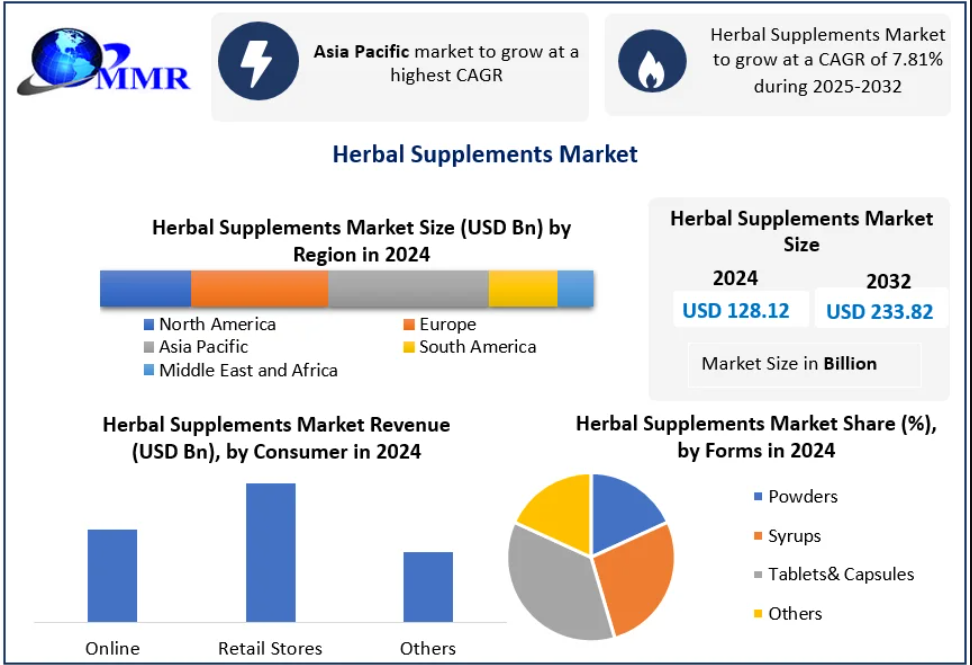
Market Size (2024): USD 128.12 Billion
Forecast (2032): USD 233.82 Billion
CAGR (2025–2032): 7.81%
Herbal Supplements Market Overview
The global Herbal Supplements Market is experiencing robust expansion, driven by increasing consumer preference for natural, plant-based health solutions. Valued at USD 128.12 billion in 2024, the market is projected to reach USD 233.82 billion by 2032, supported by rising awareness of holistic wellness, preventive healthcare, and clean-label products.
Herbal supplements—including tablets, capsules, powders, syrups, liquid extracts, and gummies—continue to gain global traction as alternatives to synthetic pharmaceuticals. Their widespread availability across pharmacies, online platforms, supermarkets, health stores, and wellness clinics supports strong consumption across geographic regions and demographic groups.
Asia-Pacific remains the dominant market, supported by traditional medicine systems (Ayurveda, TCM), while North America emerges as the fastest-growing region driven by lifestyle diseases, preventive health, and premium supplement consumption.
Growing scientific validation, investments in R&D, and regulatory developments indicate a rapidly maturing industry shifting toward personalization and clinically proven botanical formulations.
Click here to claim your free sample report and uncover the most lucrative market segments:https://www.maximizemarketresearch.com/request-sample/20657/
Herbal Supplements Market Dynamics
Drivers
Rising Health Awareness & Shift Toward Natural Wellness
Sedentary lifestyles, growing mental health concerns, and rising chronic diseases are pushing consumers toward safer, natural, and affordable health solutions. Herbal supplements are increasingly incorporated into daily routines due to minimal side effects, strengthening demand globally.
Natural Appeal & Historical Usage
Herbal medicines have been used for centuries for various therapeutic purposes. The perception of purity, non-toxicity, and long-term health benefits significantly fuels consumer trust and adoption.
Economic Factors & Rising Healthcare Costs
Expensive medical treatments and tighter government healthcare budgets are encouraging consumers to choose cost-effective herbal alternatives.
Personalized Nutrition & Sports Lifestyle Trends
The rise of customized nutrition, sports nutrition, and dietary supplements creates strong opportunities. Athletes and fitness-conscious consumers are increasingly adopting herbal products for endurance, immunity, and recovery.
Restraints
Complex & Varying Global Regulations
Inconsistent global regulatory frameworks complicate product approvals, labeling, testing, and ingredient standardization.
Quality & Safety Challenges
Herbal raw material variability, adulteration risks, and inconsistent formulations hinder consumer trust and pose barriers for producers.
Cultural Preferences
Acceptance varies across regions depending on traditional practices, beliefs, and exposure to herbal remedies.
Competition From Pharmaceuticals
For acute conditions, synthetic drugs remain the preferred choice, challenging herbal supplements’ market penetration.
Opportunities
AI-Based Personalized Herbal Supplementation
Advancements in digital wellness apps, DNA-based nutrition plans, and AI-driven product recommendations are transforming consumer engagement.
Rising Investments in R&D & Clinical Trials
Brands are increasingly validating claims through scientific research to gain regulatory acceptance and consumer trust.
Expansion in Sports Nutrition, Women’s Health & Mental Wellness
Trending ingredients—Ashwagandha, Elderberry, Turmeric, Maca, and Ginseng—are gaining strong traction for stress relief, immunity, hormonal balance, and performance enhancement.
Challenges
Strict regulatory compliance standards
Fragmented global market with numerous SMEs
Biodiversity pressure due to high raw-material demand
Shifting trends in wellness influencing product lifecycle
Herbal Supplements Market Segment Analysis
By Form
Tablets & Capsules (Dominant Segment)
Leading due to convenience, accurate dosage, long shelf life, and strong consumer trust.
Powders gaining traction among fitness users for customizable dosing.
Syrups preferred by elderly and pediatric consumers.
Others (gummies, liquid extracts, softgels) showing fastest growth due to taste, bioavailability, and innovation.
By Distribution Channel
Pharmaceutical Stores (Largest Share)
Due to credibility, expert consultation, and verified product availability.
Online Retail (Fastest Growing)
Growth driven by convenience, discounts, and wide product range.
Personal Care & Specialty Stores
Popular for beauty and wellness formulations.
Others (Direct sales, clinics) serve niche therapeutic markets.
By Consumer Purchase Channel
Retail Stores (Largest Share) due to trust and physical product verification.
Online Platforms rapidly increasing among millennials and Gen Z.
Others include wellness clinics and direct selling networks.
Click here to claim your free sample report and uncover the most lucrative market segments:https://www.maximizemarketresearch.com/request-sample/20657/
Regional Insights
Asia Pacific – Market Leader (42% Share)
Strong traditional medicine practices in India and China
Exports account for >60% of global herbal ingredients
Policies like India's AYUSH Mission 2025 support formalization and innovation
Challenges: price sensitivity and market fragmentation
North America – Fastest Growing Market
65% of U.S. adults use dietary supplements
Premium botanical products and holistic healthcare trends booming
FDA intensifying regulations for purity and transparency
Strong e-commerce influence (Amazon’s “Verified Herbal Supplements”)
Europe – Quality-Focused Market
Germany and Switzerland lead due to stringent organic certifications
Consumers demand clinically proven formulations
EU tightening quality controls on imported ingredients
Middle East, Africa & South America
Rising adoption driven by urbanization, wellness awareness, and expanding pharmacy retail networks.
Competitive Landscape
The market is moderately fragmented, with global leaders expanding portfolios while regional brands leverage traditional systems and local ingredients.
Key Global Players
Nature’s Bounty / NBTY
Archer Daniels Midland Company (ADM)
Herbalife International
NOW Health Group
Swanson Health
Glanbia PLC
Asia-Pacific Leaders
Himalaya Herbal Healthcare
Naturalife Asia
Herbochem
Nutrova
North American Leaders
Nutraceutical Corporation
Jarrow Formulas
Herb Pharm
Bio-Botanica
European Leaders
Ricola AG
Blackmores (strong EU presence)
Competitive strategies include:
R&D investment, clinical validation, mergers, regulatory alignment, digital marketing, and personalized product lines.
Recent Key Developments (2024–2025)
North America
FDA strengthens botanical labeling regulations (2024)
Nature’s Bounty launches clinically studied Ashwagandha for stress relief (2025)
Asia Pacific
Himalaya expands USDA-certified organic portfolio in the U.S. (2024)
China approves 10 new TCM herbal exports (2025)
Europe
EU enforces stricter controls on imported herbal raw materials (2024)
Key Market Trends
Rise of science-backed herbal formulations
Brands are conducting clinical trials on Ashwagandha, Turmeric, Elderberry, Ginseng, etc., to support therapeutic claims.
Personalized Herbal Nutrition & Digital Wellness
AI platforms create customized supplement plans; subscription models and influencer-led marketing drive demand.
Clean-label, organic, and sustainably sourced ingredients
Transparency in sourcing, processing, and supply chain ethics is becoming essential.
Conclusion
The Herbal Supplements Market is evolving rapidly, driven by consumer demand for natural, preventive, and personalized health solutions. With rising scientific validation, digital transformation, and global regulatory improvements, the sector is transitioning from traditional remedies to a sophisticated, evidence-based global industry.
Asia Pacific remains the manufacturing hub and highest-revenue region, while North America leads in innovation and premium product adoption. Companies that invest in R&D, transparency, personalization, and global expansion are likely to dominate the market through 2032.