 Your Ideas OS
Log in to learn from real founders, exchange ideas, and work on businesses that move from concept to execution.
Access Knowasiak
Join the conversations shaping real businesses.


Optical Communication and Networking Market Size and Emerging Trends 2025-2032
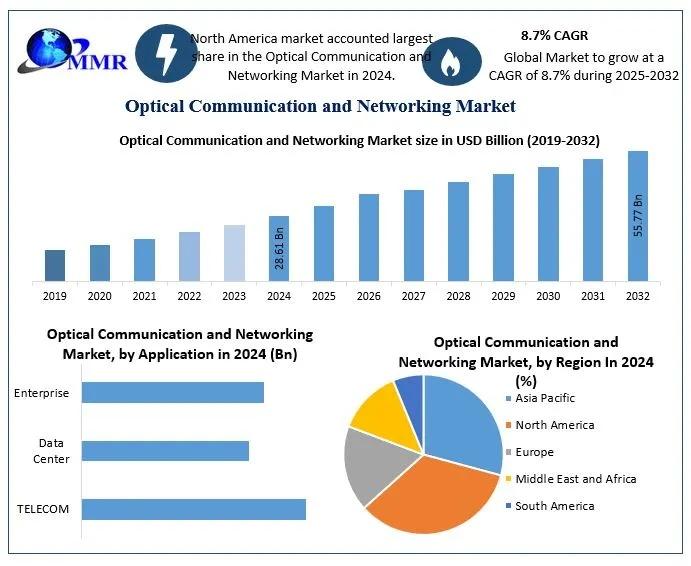
Anticipated Growth in Revenue: The Optical Communication and Networking Market size was valued at USD 28.61 Billion in 2024 and the total Optical Communication and Networking revenue is expected to grow at a CAGR of 8.7% from 2025 to 2032, reaching nearly USD 55.77 Billion.
Optical Communication and Networking Market Overview
The report focuses on key players in the Optical Communication and Networking industry, highlighting their strategic ambitions and growth strategies. The research evaluates a range of industry methods, including mergers and acquisitions, government and corporate transactions, partnerships and collaborations, joint ventures, brand promotions, and product launches. The latest Market Research Report presents a comprehensive analysis of the market, encompassing precise definitions, classifications, applications, and the industry's chain structure. With impartial and expert commentary, this report offers valuable insights into the present market scenario. It delves into crucial aspects such as market performance, production and consumption rates, demand and supply dynamics, and projected income generation for the forecast period. Moreover,
Optical Communication and Networking Market Scope and Methodology:
The Maximize Market Research report provides an extensive analysis of the Optical Communication and Networking market using a dynamic research methodology. It offers insights into key growth drivers, market dynamics, challenges, and scope, supported by PESTAL, PORTER, and SWOT analysis.
The report captures the latest developments and emerging technologies in the global Optical Communication and Networking market. It presents comprehensive information, including market shares, supply chain analysis, and key success factors, to understand the global Optical Communication and Networking market landscape. Industry experts from leading organizations in the global Optical Communication and Networking market share their insights and opinions in the concluding section of the report.
Request a Sample of the Full Market Report:https://www.maximizemarketresearch.com/request-sample/7169/
Optical Communication and Networking Market Regional Insights
The Optical Communication and Networking Market is divided into North America, South America, Europe, the Middle East and Africa, and Asia Pacific, according to regional analysis. Several areas are home to nations such as the United States, Canada, Mexico, United Kingdom, Germany, France, Spain, Italy, Rest of Europe, China, India, Japan, Australia, and South Korea.
Optical Communication and Networking Market Segmentation
by Component
Optical Fibers
Optical Transceivers
Optical Amplifiers
Optical Switches
Optical Splitters
Optical Circulators
Others
by Technology
SONET/SDH
WDM
CWDM
DWDM
Fiber Channel
by Application
TELECOM
Data Center
Enterprise
by Data Rate
Up To 40 GBPS
Greater Than 40 Gbps To 100 Gbps
Greater Than 100 Gbps
by Vertical
BFSI
Government
Healthcare
Cloud
Energy & Utilities
Others
Optical Communication and Networking Market Key Players
1. Ciena
2. ADVA Optical Networking
3. Ericsson
4. Corning
5. Oclaro
6. Mitsubishi Electric
7. Huawei
8. Cisco
9. Sumitomo
10. Nokia
11. Amazon
12. Apple
13. Microsoft
14. Google
15. Facebook
16. Infinera
17. NEC
18. Calix
19. ADTRAN
20. ZTE
Get Your Complimentary Sample Report Today :https://www.maximizemarketresearch.com/request-sample/7169/
Key questions answered in the Optical Communication and Networking Market are:
What is Optical Communication and Networking?
What is the growth rate of the Optical Communication and Networking Market?
Which are the factors expected to drive the Optical Communication and Networking market growth?
What are the different segments of the Optical Communication and Networking Market?
What growth strategies are the players considering to increase their presence in Optical Communication and Networking?
What are the upcoming industry applications and trends for the Optical Communication and Networking Market?
What are the recent industry trends that can be implemented to generate additional revenue streams for the Optical Communication and Networking Market?
Who are the leading companies and what are their portfolios in Optical Communication and Networking Market?
What segments are covered in the Optical Communication and Networking Market?
Who are the key players in the Optical Communication and Networking market?

Consumer Analytics in the Automotive Industry: Driving Better Business Outcomes with Holistic Insights from Grand View Brainshare
The automotive industry is undergoing a profound transformation driven by electrification, digitalization, sustainability, and changing mobility preferences. Consumers today expect more than just reliable transportation; they demand connected experiences, personalized services, environmentally responsible products, and seamless digital interactions. As competition intensifies and new entrants reshape the mobility ecosystem, automotive companies must develop a deeper understanding of consumer behavior to remain competitive.
Consumer analytics has therefore become a strategic priority for organizations seeking to design customer-centric products, refine marketing strategies, and improve overall business performance. Through its advisory and consulting division, Grand View Brainshare, part of Grand View Research, provides advanced consumer analytics solutions that help automotive stakeholders convert data into meaningful insights. By combining data analytics, market research, and behavioral analysis, Brainshare enables companies to understand customers holistically and make informed strategic decisions.
Shifting Consumer Dynamics in the Automotive Sector
Over the past decade, consumer expectations in the automotive industry have evolved significantly. Factors such as sustainability awareness, digital connectivity, and evolving urban mobility patterns are influencing purchasing decisions. The growing popularity of electric vehicles, for example, reflects increasing environmental consciousness and government support for clean mobility. Automakers such as Tesla, Inc. have redefined consumer expectations by offering vehicles that integrate software updates, advanced infotainment systems, and autonomous driving features. Traditional manufacturers including Toyota Motor Corporation and Ford Motor Company are also investing heavily in electrification and connected vehicle technologies to meet changing customer demands.
In this environment, companies must go beyond traditional market research and leverage consumer analytics to gain a deeper understanding of customer attitudes, usage patterns, and decision-making processes. These insights allow organizations to design products and services that align with evolving mobility needs.
The Role of Consumer Analytics in Automotive Strategy
Consumer analytics refers to the systematic collection and analysis of customer data to identify patterns, preferences, and behavioral trends. Within the automotive industry, this intelligence plays a crucial role in shaping product development, marketing strategies, pricing models, and customer engagement initiatives.
Grand View Brainshare’s consumer analytics solutions provide automotive companies with a comprehensive view of the customer lifecycle from initial awareness and product consideration to purchase, ownership experience, and brand loyalty. By integrating multiple research methodologies, the service delivers insights that enable organizations to build stronger relationships with their customers and enhance overall market competitiveness.
Understanding Consumer Attitudes and Usage Patterns
One of the fundamental aspects of consumer analytics is Usage and Attitude (U&A) analysis, which examines how consumers interact with automotive products and services. This includes evaluating vehicle usage frequency, driving behavior, brand perception, and satisfaction levels. For instance, consumers purchasing electric vehicles may prioritize charging infrastructure availability, battery performance, and long-term cost savings. By analyzing these preferences, automakers can refine product features and design solutions that address key consumer concerns.
Brainshare’s U&A studies help automotive companies identify emerging behavioral trends, enabling them to adapt their strategies in response to changing market dynamics. Such insights are particularly valuable in fast-growing segments like electric mobility and connected vehicles.
Mapping the Automotive Customer Journey
Another important component of consumer analytics is customer journey mapping, which tracks the various stages of the consumer decision-making process. In the automotive sector, this journey typically includes awareness, research, dealership interaction, purchase, and post-sale engagement. Digital platforms now play a significant role in this process. Many consumers conduct extensive online research before visiting a dealership, comparing vehicle specifications, prices, and reviews across multiple brands. Companies such as Volkswagen AG and General Motors are investing in digital retail platforms to improve customer experience and streamline purchasing processes.
By analyzing customer journey data, Brainshare helps automotive companies identify key touchpoints that influence purchasing decisions. This allows organizations to optimize marketing campaigns, enhance dealership experiences, and deliver personalized engagement strategies that improve conversion rates.
Brand Health and Market Perception
Brand perception is a critical factor influencing automotive purchasing decisions. Consumer analytics enables companies to track brand awareness, customer satisfaction, and loyalty metrics over time. Through brand health tracking, organizations can evaluate how consumers perceive their brand compared to competitors. For example, premium brands may focus on attributes such as innovation, performance, and luxury, while mass-market manufacturers emphasize affordability, reliability, and efficiency.
By analyzing brand sentiment across various channels, including digital platforms and social media, Brainshare provides valuable insights into consumer perception. This enables automotive companies to refine their messaging, strengthen brand positioning, and build long-term customer trust.
Concept Testing and Product Innovation
Consumer analytics also plays a vital role in supporting product development and innovation. Concept testing allows companies to evaluate new vehicle designs, features, and marketing concepts before launching them in the market. For example, emerging technologies such as advanced driver-assistance systems, connected infotainment platforms, and electric powertrains require careful evaluation to ensure they meet consumer expectations. Automakers like Hyundai Motor Company and BMW Group frequently conduct consumer testing to assess the appeal of new technologies and design concepts.
Brainshare’s concept testing frameworks enable automotive companies to gather direct feedback from target audiences, reducing product development risks and increasing the likelihood of successful market adoption.
Leveraging Social Media and Digital Insights
Social media platforms and digital channels provide a wealth of real-time consumer data. Monitoring online conversations, product reviews, and customer feedback allows companies to track emerging trends and respond quickly to market shifts.
Consumer analytics solutions from Grand View Brainshare integrate social listening and sentiment analysis to provide a deeper understanding of consumer opinions. These insights help automotive companies identify potential brand risks, evaluate campaign performance, and uncover opportunities for product improvement.
Enabling Data-Driven Business Outcomes
In an industry characterized by rapid innovation and intense competition, automotive companies must rely on accurate consumer insights to guide their strategic decisions. Consumer analytics provides the analytical framework required to understand evolving customer needs and translate those insights into actionable business strategies.
Grand View Brainshare combines primary research, advanced analytics, and proprietary market data to deliver holistic consumer intelligence. By integrating insights across multiple data sources, the service enables automotive organizations to design customer-centric strategies that improve product adoption, strengthen brand loyalty, and enhance overall business performance.
Conclusion
The automotive industry is evolving at an unprecedented pace, with technological innovation and shifting consumer preferences redefining the future of mobility. To remain competitive in this dynamic environment, companies must adopt a comprehensive approach to understanding their customers.
Through its consumer analytics solutions, Grand View Brainshare empowers automotive stakeholders with holistic consumer insights that drive better business outcomes. By analyzing consumer attitudes, mapping customer journeys, monitoring brand perception, and testing new concepts, the service helps organizations create strategies that align with modern mobility expectations and deliver sustainable growth in the global automotive market.
Book a Custom Strategy Consultation with Grand View Brainshare to Discover Your Next Growth Opportunity

BRAINSHARE | Business Consulting and Advisory Services
Expert advisory & consulting services such as Opportunity Assessment, Go-to-Market Strategy, Competitive Intelligence & Benchmarking, Consumer Analytics
https://www.grandviewresearch.com/services/brainshare#fill-form)

Europe’s beer landscape is undergoing a remarkable transformation. Beyond the familiar lagers and pilsners, a vibrant movement is brewing, driven by a thirst for flavor, authenticity, and local character. The craft beer revolution has firmly taken root, with thousands of independent breweries offering an astonishing array of styles and experiences. According to a recent report by IMARC Group, the Europe craft beer market is on a robust growth trajectory. Valued at USD 42.7 Billion in 2025, the market is projected to reach USD 73.2 Billion by 2034, expanding at a compound annual growth rate (CAGR) of 6.18% from 2026 to 2034. This growth is fueled by a consumer shift towards diverse, artisanal products, the rise of beer tourism, and a strong focus on sustainability.
Read the full report here: https://www.imarcgroup.com/europe-craft-beer-market
Key Takeaways:
The Europe craft beer market size was valued at USD 42.7 Billion in 2025 and is forecast to reach USD 73.2 Billion by 2034.
The market is expected to grow at a CAGR of 6.18% during the 2026-2034 period.
By product type, the market is segmented into ales, lagers, and others, with ales being a dominant category.
By age group, key consumers include those aged 21-35, 40-54, and 55 years and above.
By distribution channel, the market serves both on-trade (bars, pubs, restaurants) and off-trade (retail).
A key challenge is navigating intense competition and maintaining differentiation in a rapidly saturating market.
Major business opportunities lie in beer tourism and sustainable packaging and brewing practices.
Growth Drivers of the Europe Craft Beer Market
Diverse Offerings from Craft Beer Providers
A primary driver for the market is the sheer diversity of flavors and styles offered by craft breweries, which directly caters to a growing consumer desire for novel and artisanal experiences. Unlike mass-produced beers, craft breweries experiment with a wide range of ingredients and techniques, producing everything from intensely hoppy India pale ales (IPAs) and rich, dark stouts to tart sours and innovative experimental brews. This variety appeals to consumers seeking alternatives and willing to explore new taste profiles, providing a more nuanced and engaging drinking experience. The scale of this movement is significant. According to The Brewers of Europe’s data, there are over 10,000+ breweries across the European continent, which has created over 2 million jobs, from production to delivery. The industry is witnessing constant launches of exceptional products focused on catering to unique taste preferences, ensuring that there is always something new for consumers to discover, thereby sustaining long-term interest and market growth.
Enhanced Brewery Experiences with Beer Tourism
The rise of beer tourism is a powerful trend significantly boosting the visibility and accessibility of craft beer. Beer enthusiasts are now traveling to different regions to explore and discover new breweries, turning a simple drink into a travel experience. Many craft breweries have opened their doors to visitors, offering tours, tastings, and on-site experiences that go beyond the simple purchase of a beverage. This immersive trend allows consumers to connect with the brand story, meet the brewers, and appreciate the craftsmanship behind the product. This influx of beer tourists stimulates local economies, with breweries forming strategic partnerships with local restaurants, hotels, and attractions to create enhanced travel packages. This collaborative approach not only boosts the overall appeal of beer tourism but also draws in a steady stream of enthusiastic and engaged consumers, supplementing the market's growth by creating loyal brand advocates.
Threats Facing the Europe Craft Beer Market
Navigating Intense Competition and Maintaining Differentiation
The craft beer market's success has led to its biggest challenge: intense and growing competition. With over 10,000 breweries across Europe, the market is becoming increasingly saturated. For new and existing breweries, standing out requires constant innovation in flavor profiles, brewing techniques, and marketing strategies. The challenge is to maintain a unique identity and brand loyalty amidst a flood of options. The solution lies in a relentless focus on authenticity, quality, and community engagement. Breweries can differentiate themselves by hyper-localizing their ingredients, forging deep ties with their communities, and creating unique taproom experiences that go beyond just selling beer. Embracing niche styles (like historical or regional recipes) and telling compelling brand stories can also create a dedicated following. For B2B audiences, such as distributors and retailers, the key is to curate a portfolio that balances well-established names with unique, high-quality local players, rather than simply stocking the largest number of brands.
Opportunities in the Europe Craft Beer Market
Expanding Beer Tourism and Experiential Marketing
The growth of beer tourism presents a massive opportunity for craft breweries to diversify their revenue streams and build stronger brand loyalty. By investing in creating memorable visitor experiences—such as guided tastings, behind-the-scenes tours, food pairings, and on-site brewing classes—breweries can transform their taprooms into destinations. Strategic partnerships with local hotels, tour operators, and restaurants can create packaged travel experiences that attract visitors from across Europe and beyond. This not only generates direct revenue from tours and on-site sales but also creates a powerful word-of-mouth marketing engine, as visitors become brand ambassadors. For breweries, this is a chance to build a direct connection with their most passionate consumers, creating a loyal customer base that extends far beyond their local geographic area.
Get Instant Access to Critical Industry Data
Europe Craft Beer Market Segmentation
According to the analysis by IMARC Group, the Europe craft beer market is segmented based on product type, age group, distribution channel, and country, providing a detailed view of its structure.
Analysis by Product Type:
Ales: A diverse category including India Pale Ales (IPAs), stouts, porters, and sours, characterized by top-fermenting yeast and often complex, fruity, or roasted flavors. This is a dominant category.
Lagers: Bottom-fermented beers known for their clean, crisp profiles. Craft versions offer variations on traditional styles like pilsners, bocks, and dunkels.
Others: Includes other beer styles and experimental brews that don't fit neatly into the ale or lager categories.
Analysis by Age Group:
21-35 Years Old: A key demographic driving the flavor revolution, seeking new experiences and willing to experiment with diverse styles.
40-54 Years Old: A demographic with established palates and higher disposable income, often seeking premium and artisanal products.
55 Years and Above: A growing segment appreciating quality, tradition, and moderate consumption.
Analysis by Distribution Channel:
On-Trade: Beer consumed on the premises where it is purchased, including bars, pubs, restaurants, hotels, and brewery taprooms.
Off-Trade: Beer purchased for consumption off the premises, including supermarkets, hypermarkets, specialty beer shops, and online stores.
Analysis by Country:
Germany: A major market with a rich brewing tradition and a growing number of innovative craft breweries.
France: A rapidly growing market with an increasing number of microbreweries and a strong focus on gastronomy.
United Kingdom: A mature and highly developed market with a long history of craft brewing and a vibrant pub culture.
Italy: A growing market with a strong emphasis on food pairings and artisanal production.
Spain: An emerging market with increasing consumer interest in craft beer, particularly in urban centers.
Others: Other European countries, including emerging economies like Romania, Croatia, and Serbia, showing substantial growth.
Europe Craft Beer Market News
In April 2024, DW Reusables announced plans to launch packaging produced from 100% post-consumer plastic waste for the beverage industry.
Berlin-based craft brewery Fuerst Wiacek has implemented sustainable practices including recycling spent grain for livestock feed and sourcing energy from solar power, using distinctive tin packaging with a high recycling rate.

Europe Craft Beer Market Size, Share & Trends Report, 2026
Europe craft beer market size reached USD 42.7 Billion in 2025 to reach USD 73.2 Billion by 2034 at a CAGR of 6.18% during 2026-2034.
https://www.imarcgroup.com/europe-craft-beer-market/
Why is AI becoming the ultimate virtual assistant in cannabis retail?
Imagine an AI Virtual Budtender who knows the terpene profile of every product in your inventory, remembers each customer’s preferences from months ago, and can effortlessly explain concepts like live resin without missing a beat.
That’s exactly what modern AI is bringing to cannabis retail.
With the power to process massive datasets in real time, AI Virtual Budtenders are transforming the customer experience through:
Hyper-Personalization
Matching each customer’s mood, wellness needs, or desired effects with the precise cannabinoid and terpene profile.
Consistency at Scale
Delivering expert-level recommendations to every customer—every time—without variability.
Smart Data-Driven Upselling
Recommending complementary products, accessories, or edibles based on customer behavior and cart insights.
24/7 Intelligent Engagement
Always available, always learning, and always improving customer interactions across channels.
The future of dispensary retail isn’t just digital—it’s intelligent, personalized, and powered by AI Virtual Budtenders.
https://www.tumblr.com/askbud-i/811855194711277569/top-ai-powered-budtender-software-to-increase?source=share
#AIChatbot #CannabisAI #VirtualBudtender #DispensaryMarketing #CustomerRetention #ChatbotAutomation #SaaS #AIForBusiness #RetailAI #leadgeneration #Omnichannel



How to Align Messaging Across Multiple Advertising Platforms
In a multi-platform world, disjointed ads kill conversions. Cross-media ad strategies unify your message for max impact.
Why it matters: Boost recall 30%, cut waste. Audit creatives, build a messaging pyramid (hero hook + pillars), tweak for platforms.
Quick steps:
• Map journeys.
• Use DCO tools.
• Consistent visuals.
• Measure ROAS.
Example: Dubai client synced channels—2.5x leads! Dodge pitfalls like over-customization. Future: AI personalization.
Unlock cohesive funnels: https://ciente.io/blogs/cross-media-ad-strategies/