 Your Ideas OS
Log in to learn from real founders, exchange ideas, and work on businesses that move from concept to execution.
Access Knowasiak
Join the conversations shaping real businesses.


Coffee Beans Market Outlook with Key Drivers, Challenges, and Opportunities 2032
Coffee Beans Market Analysis 2025-2032
Market Size & Forecast
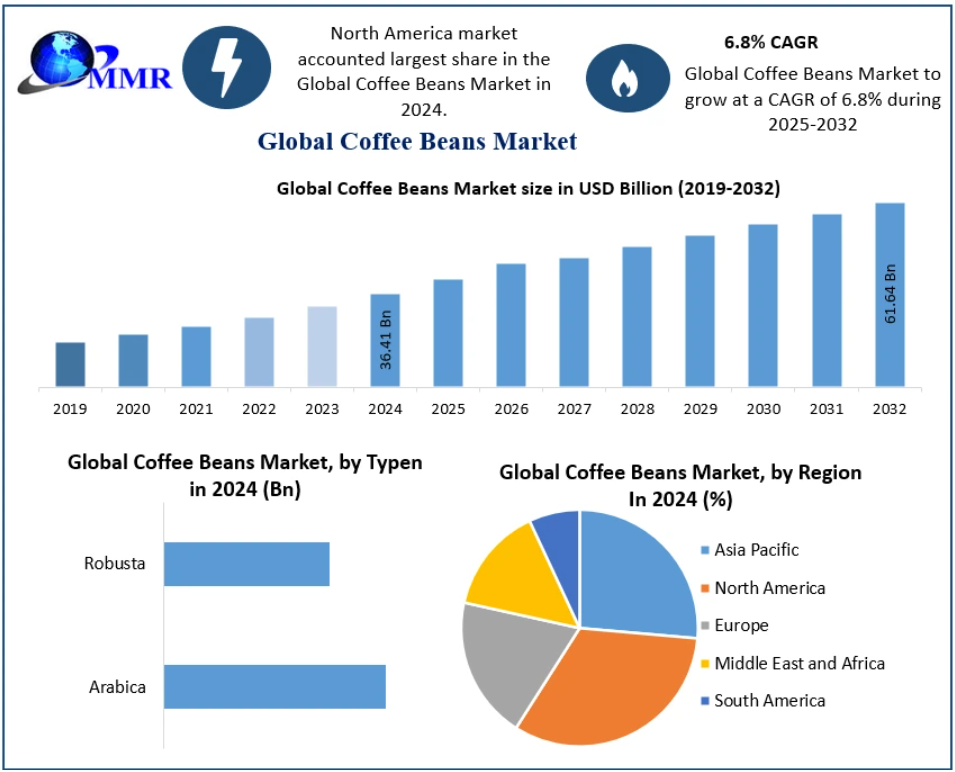
The global Coffee Beans Market was valued at USD 36.41 Billion in 2024 and is projected to grow at a CAGR of 6.8% from 2025 to 2032, reaching nearly USD 61.64 Billion by 2032.
Coffee continues to be one of the most widely consumed beverages globally, with a variety of preparation styles such as espresso, cappuccino, latte, and americano, appealing to diverse consumer preferences. Coffee beans, the seeds of the Coffea plant found within the red or purple fruit known as coffee cherries, are the foundation of this growing industry. While not true beans, coffee seeds are processed similarly and have become essential agricultural commodities.
Market Overview
The global coffee market is primarily dominated by Arabica (≈60%) and Robusta (≈40%) beans. Arabica beans are known for their mild, sweet flavor and lower caffeine content (0.8–1.4%), whereas Robusta beans are stronger, more bitter, and higher in caffeine (1.7–4.0%). Coffee is not only a major contributor to the energy-boosting beverage market but also offers health benefits, including liver protection, heart health, and reduced risk of neurodegenerative diseases.
Coffee beans are a critical cash crop and a significant source of foreign exchange for many developing countries. Historically, around 70% of global coffee production has been exported, making it a key driver of international trade.
To know the most attractive segments, click here for a free sample of the report:https://www.maximizemarketresearch.com/request-sample/118497/
Market Dynamics
Drivers:
Rising Coffee Consumption: Growing popularity of coffee among younger populations in countries like India, China, and the Philippines, coupled with the expansion of cafes and specialty coffee shops, is fueling demand. Coffee consumption is increasingly influenced by lifestyle trends, socializing habits, and workplace culture.
Health Benefits: Coffee beans are associated with potential health advantages, including reducing the risk of type 2 diabetes, cardiovascular diseases, and certain cancers. Antioxidants and minerals such as magnesium and chromium contribute to these health benefits.
Expansion into Cosmetics: Coffee’s antioxidant properties have led to its inclusion in skincare and personal care products, including scrubs, face masks, and lip balms. Brands like Mcaffeine are leveraging coffee extracts for cosmetic applications.
Use in Food & Beverages: Coffee beans are increasingly utilized in bakery items, desserts, ice creams, and beverages, including coffee-flavored liquors and cocktails, stimulating demand for high-quality beans.
Challenges:
Counterfeit Coffee Products: Adulteration of coffee beans with cheaper ingredients or mislabeling of Robusta as Arabica poses quality and safety concerns.
Coffee Alternatives: Products like chicory root offer caffeine-free alternatives with similar flavor profiles, potentially limiting growth.
Segment Analysis
By Type:
Arabica: Dominated the market in 2024 with 61.2% share, driven by its mild flavor and lower caffeine content, and its use in chocolates, nuts, and specialty coffee blends.
Robusta: Expected to grow at a CAGR of 7.4%, favored for its stronger flavor, higher caffeine content, and use in energy drinks and instant coffee products.
By Application:
Food & Beverages: Largest segment with over 70% market share in 2024. Includes coffee beverages, bakery products, desserts, and dietary supplements.
Pharmaceuticals: Fastest-growing segment, projected at CAGR 10.3%, driven by the health benefits of green coffee beans and antioxidant-rich extracts.
Cosmetics: Growing demand for coffee-based personal care products such as scrubs, face washes, and moisturizers.
By Distribution Channel:
Online: Increasing e-commerce penetration is facilitating direct-to-consumer sales and specialty coffee subscriptions.
Offline: Coffee shops, retail stores, and supermarkets remain primary sales channels, particularly in urban regions.
Regional Insights
North America: Largest market with 30.2% share in 2024, driven by high consumption rates, coffee vending machines, and a robust café culture. The U.S. remains the largest importer of coffee globally, while Brazil leads in production.
Asia-Pacific: Expected to grow at the highest CAGR of 6.0%, fueled by rising coffee shop penetration, growing middle-class populations, and the region’s suitability for coffee cultivation. Countries such as India, Thailand, the Philippines, Indonesia, and Vietnam are key contributors.
Middle East & Africa (MEA): Projected to grow at a CAGR of 9.9%, due to rising coffee consumption and entry of pharmaceutical and cosmetic companies leveraging coffee-based ingredients.
To know the most attractive segments, click here for a free sample of the report:https://www.maximizemarketresearch.com/request-sample/118497/
Research Methodology
The market research relies on primary and secondary data sources, including government policies, industry trends, competitive landscape, and technological innovations. Market forecasts account for factors such as inflation, regulatory changes, and economic cycles. Quantitative and qualitative analyses provide comprehensive insights into market size, revenue potential, and growth trends across key segments and regions.
Competitive Landscape
The global coffee beans market is highly competitive, featuring multinational corporations, specialty coffee brands, and regional players. Leading companies include:
Steamy Beans Coffee
The Busy Bean
Boston Barista
Jumpstart Coffee
Mugs Coffee
The Steam Room
Espresso Express
Nestle
JM Smucker Company
Kraft Heinz Company
Starbucks Corporation
Keurig Dr. Pepper
F. Gavina and Sons, Inc.
JDE Peet's
AMT Coffee Ltd
Lavazza
Trung Nguyen
Report Scope
Report Coverage
Details
Base Year
2024
Forecast Period
2025–2032
Historical Data
2019–2024
Market Size (2024)
USD 36.41 Bn
Forecast CAGR
6.8%
Market Size (2032)
USD 61.64 Bn
Segments Covered:
By Type: Arabica, Robusta
By Application: Food & Beverages, Pharmaceuticals, Cosmetics
By Distribution Channel: Online, Offline
Regions Covered:
North America, Europe, Asia-Pacific, Middle East & Africa