 Your Ideas OS
Log in to learn from real founders, exchange ideas, and work on businesses that move from concept to execution.
Access Knowasiak
Join the conversations shaping real businesses.


Logistics Market Transformation Powered by Smart Warehousing Trends 2032
Global Logistics Market – Smart, Fast & Digitally Driven Supply Chains
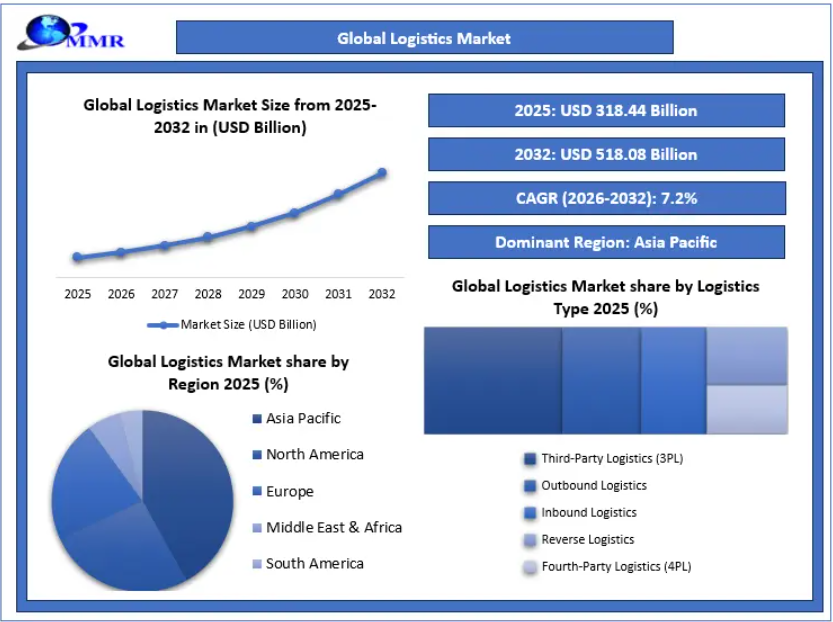
The global Logistics Market is undergoing a rapid transformation, evolving into a technology-driven, customer-centric ecosystem. Valued at USD 318.44 billion in 2025, the market is projected to reach USD 518.08 billion by 2032, expanding at a CAGR of 7.2%. This growth is fueled by explosive e-commerce demand, digital logistics platforms, AI-powered supply chains, and smart multimodal transportation systems.
Market Overview: The Backbone of Global Trade
Logistics today goes far beyond transportation—it integrates warehousing, inventory management, order fulfillment, and last-mile delivery into a seamless global network. The rise of real-time tracking, predictive analytics, and automation is enabling faster, more efficient, and transparent supply chains.
E-commerce boom: Sales surged from USD 4.98T (2021) to USD 6.86T (2025)
Online shoppers: Reached ~2.77 billion globally
Last-mile evolution: Delivery times reduced to ~2.15 days (2023)
Automation: Over 53% of logistics firms use robotics
👉 Request a Free Sample Copy or View Report Summary:https://www.maximizemarketresearch.com/request-sample/94795/
Key Growth Drivers
E-commerce Expansion
The surge in online retail is the primary growth engine for logistics. Increasing cross-border trade and same-day delivery expectations are pushing companies to expand fulfillment centers, 3PL services, and digital infrastructure.
Automation & Smart Warehousing
Robotics, AI, and automated storage systems are transforming warehouses into high-speed fulfillment hubs, handling millions of shipments daily with minimal human intervention.
IoT & Real-Time Visibility
With 48% adoption in advanced economies, IoT-enabled sensors provide real-time shipment tracking, improving delivery accuracy and customer satisfaction.
AI-Driven Supply Chains
AI enables demand forecasting, route optimization, and predictive maintenance, reducing costs and enhancing operational efficiency.
Emerging Market Trends
Faster Last-Mile Delivery Revolution
Consumer expectations for ultra-fast delivery are reshaping logistics strategies:
Micro-fulfillment centers in urban areas
Electric vehicles & drones for eco-friendly delivery
Smart parcel lockers & contactless delivery
Focus on green logistics to reduce emissions
Projection: Last-mile deliveries expected to grow 78% by 2030
Regional Insights: Asia Pacific Leads the Race
Asia Pacific dominates, handling 1.8+ billion parcels annually
🇨🇳 China leads with 900M+ parcels/year
🇺🇸 USA follows with 500M parcels
🇩🇪 Germany handles 400M parcels
This dominance is driven by rapid urbanization, digital commerce growth, and government-backed infrastructure investments.
Opportunities: Digital & Personalized Logistics
The next phase of growth lies in technology-enabled logistics ecosystems:
Cloud platforms for real-time coordination
Blockchain for transparency and security
AI analytics for predictive decision-making
Personalized delivery experiences
👉 Nearly 67% of cross-border operators now use digital documentation, accelerating global trade processes.
Market Challenges
Despite strong growth, the industry faces key constraints:
High logistics costs (India: ~7.97% of GDP)
Rising fuel and transportation expenses
Labor & warehousing cost pressures
Environmental concerns from urban deliveries
Solution Focus:
Multimodal transport optimization
Automation adoption
Sustainable logistics investments
Segment Insights
By Transportation Mode
Road & Air: ~45% share (speed + flexibility)
Rail: Cost-efficient for bulk cargo
Waterways: Ideal for international trade
By Service Type
Transportation & Warehousing
Inventory & Order Fulfillment
Packaging & Reverse Logistics
By Logistics Type
Inbound, Outbound
Reverse Logistics
3PL & 4PL (rapidly growing outsourcing trend)
♦ Make Smarter Decisions in 2026 — Get Your Research Report Now:https://www.maximizemarketresearch.com/market-report/global-logistics-market/94795/
Competitive Landscape
Global leaders are focusing on innovation, automation, and sustainability:
DHL, Kuehne + Nagel, DSV, UPS, Sinotrans → dominate global supply chains
Lineage Logistics & Americold → lead in cold chain logistics
Indian players (Delhivery, Blue Dart, Mahindra Logistics) → expanding rapidly in e-commerce logistics
📌 Strategic moves include:
AI-powered innovation centers
Electric delivery fleets
Expansion of cross-border logistics hubs
Future Outlook
The logistics industry is transitioning into a hyper-connected, intelligent ecosystem where speed, sustainability, and digitalization define success.
👉 By 2032, the market will be shaped by:
Autonomous delivery systems
AI-powered supply chain orchestration
Fully digitized global trade networks
Carbon-neutral logistics solutions
Conclusion
The global logistics market is no longer just a support function—it is a strategic enabler of global commerce. Companies that invest in automation, AI, IoT, and sustainable practices will lead the next wave of growth in this dynamic and competitive landscape.
◉ Get Market Research Latest Trends
Global Ship Repair and Maintenance Services Market https://www.maximizemarketresearch.com/market-report/global-ship-repair-and-maintenance-services-market/104905/
Tires Market https://www.maximizemarketresearch.com/market-report/global-tires-market/112589/
Freight Forwarding Market https://www.maximizemarketresearch.com/market-report/freight-forwarding-market/148362/
About Maximize Market Research:
Maximize Market Research is a multifaceted market research and consulting company with professionals from several industries. Some of the industries we cover include medical devices, pharmaceutical manufacturers, science and engineering, electronic components, industrial equipment, technology and communication, cars and automobiles, chemical products and substances, general merchandise, beverages, personal care, and automated systems. To mention a few, we provide market-verified industry estimations, technical trend analysis, crucial market research, strategic advice, competition analysis, production and demand analysis, and client impact studies.
Contact Maximize Market Research:
3rd Floor, Navale IT Park, Phase 2
Pune Bangalore Highway, Narhe,
Pune, Maharashtra 411041, India
[email protected]
+91 96071 95908, +91 9607365656

The Role of AI in Modern SaaS Marketing Strategies
The SaaS industry has never moved faster. With thousands of platforms competing for the same buyers, the difference between growth and stagnation often comes down to how intelligently a company markets itself. Artificial intelligence has emerged as the defining force reshaping how SaaS companies attract, convert, and retain customers and understanding the AI role in SaaS marketing strategies is no longer optional for teams that want to stay competitive.
This is not about replacing marketers with machines. It is about giving marketing teams capabilities that were unimaginable just a few years ago the ability to personalise at scale, predict buyer behaviour, automate tedious workflows, and make decisions based on real data rather than gut instinct. AI is not a trend. It is a fundamental shift in how great SaaS marketing gets done.
Why AI Has Become Essential in SaaS Marketing
SaaS marketing presents a unique set of challenges. Sales cycles can be long and complex, buying committees often involve multiple stakeholders, churn is a constant threat, and the cost of acquiring a new customer must always be weighed against lifetime value. Traditional marketing tactics broad email blasts, generic landing pages, one-size-fits-all messaging simply do not cut through at the level required to drive predictable, scalable growth.
AI addresses these challenges directly. By analysing vast amounts of behavioural and demographic data, AI tools help SaaS marketers identify who their best-fit customers are, where those customers are in the buying journey, and what message will resonate most at each stage. The result is marketing that feels less like broadcasting and more like a conversation relevant, timely, and genuinely useful to the prospect.
Hyper-Personalisation at Scale
One of the most powerful applications of AI in SaaS marketing is the ability to personalise experiences at a scale no human team could achieve manually. AI-driven platforms can analyse user behaviour across a website, product, and email campaigns to serve each visitor dynamic content tailored to their industry, role, past interactions, and stage in the funnel.
This goes well beyond inserting a first name into an email subject line. Think of a CFO visiting a SaaS pricing page and seeing ROI calculators and cost-per-seat breakdowns, while a developer visiting the same page is shown API documentation and integration capabilities. Both experiences are generated automatically, in real time, based on what AI knows about each visitor. This level of relevance dramatically improves conversion rates and reduces the friction that kills deals.
For email marketing specifically, AI tools now segment audiences with far greater sophistication than traditional rule-based systems. Instead of sending the same nurture sequence to every trial user, AI identifies patterns across thousands of users which features they have explored, how frequently they log in, where they drop off and triggers the right message at exactly the right moment to keep them moving toward conversion.
Predictive Lead Scoring and Pipeline Intelligence
Not every lead is worth the same level of attention. One of the most commercially valuable AI role in SaaS marketing strategies is predictive lead scoring using machine learning models to rank inbound leads by their likelihood to convert into paying customers.
Traditional lead scoring relies on simple criteria: job title, company size, form fills. Predictive scoring goes much deeper. It pulls in firmographic data, intent signals, product usage patterns, engagement history, and even external signals such as recent funding rounds or hiring activity to build a comprehensive picture of where a lead stands. Sales teams armed with AI-powered scoring spend less time chasing cold prospects and more time closing deals with the accounts most likely to convert.
Beyond scoring, AI provides pipeline intelligence that helps revenue teams understand which deals are at risk and why. If a prospect goes cold after a demo, AI tools can flag the change in engagement and suggest targeted actions a case study tailored to their vertical, a direct outreach from a senior team member, or a limited-time trial extension to re-engage the deal before it is lost.
AI-Powered Content Creation and SEO
Content remains the backbone of inbound SaaS marketing, but producing it consistently and at quality is resource-intensive. AI writing tools have matured significantly, enabling marketing teams to draft blog posts, landing page copy, product descriptions, ad variations, and social content far more efficiently than before.
Critically, AI does not replace the strategic thinking and subject-matter expertise that makes SaaS content authoritative. What it does is eliminate the blank-page problem, speed up first drafts, and allow writers to focus on refinement, positioning, and the editorial layer that elevates content above the noise. Teams that use AI as a multiplier rather than a replacement consistently outproduce those that do not.
On the SEO side, AI tools analyse search intent at a far more granular level than keyword research tools of the past. They identify topic clusters, surface content gaps, suggest internal linking strategies, and monitor how algorithm updates affect rankings giving SaaS SEO teams a systematic, data-driven approach to organic growth that compounds over time.
Reducing Churn Through Predictive Customer Intelligence
Acquisition is only half the battle in SaaS. Retention is where sustainable revenue is built. AI plays a transformative role in churn prevention by monitoring product usage signals that indicate when a customer is at risk of cancellation before they ever raise their hand to leave.
Machine learning models trained on historical churn data learn to recognise the early warning signs: declining logins, reduced feature adoption, failure to complete key onboarding steps, or a drop in the number of active seats. When these signals appear, automated workflows can trigger proactive outreach a check-in from a customer success manager, an in-app prompt highlighting an underused feature, or a personalised webinar invitation aligned to the customer's use case.
The commercial impact of this is significant. Reducing monthly churn by even a fraction of a percentage point has a compounding effect on annual recurring revenue that far outweighs the cost of the AI tooling required to achieve it.
Paid Advertising and Campaign Optimisation
SaaS companies typically spend a meaningful portion of their marketing budget on paid acquisition. AI has made this spend significantly more efficient. From Google Performance Max campaigns to Meta's Advantage+ targeting, AI-native advertising platforms now handle bid optimisation, audience segmentation, and creative testing automatically learning in real time from conversion data to allocate budget where it drives the best results.
For SaaS marketers running their own paid programmes, AI tools analyse multi-touch attribution data to build a clearer picture of which channels and touchpoints actually drive pipeline. This moves budget decisions away from last-click assumptions and toward a more accurate understanding of how the full buyer journey works enabling smarter allocation across search, social, display, and review platforms.
Building an AI-Ready Marketing Strategy
Adopting AI in SaaS marketing is not about purchasing a single platform and hoping for results. It requires a deliberate strategy starting with clean, well-structured data, choosing tools that integrate with existing CRM and marketing infrastructure, and building a culture where marketers are curious about experimentation and comfortable iterating based on what the data shows.
The SaaS companies winning today are those that treat AI as a strategic capability rather than a tactical shortcut. They invest in the right foundations, empower their teams to use AI tools confidently, and continuously refine their approach as the technology evolves. The AI role in SaaS marketing strategies will only deepen from here and the gap between companies that embrace it and those that do not is already widening.
For SaaS marketers, the question is not whether to adopt AI. It is how quickly and how thoughtfully they can make it central to everything they do.



What are The Best iPad Apps for Inbound Marketing?
In this Blog, we are going to explain the top iPad apps for inbound marketing. Techno Edge Systems LLC offers Apple iPad Rental Services in Dubai, Call us at 054-4653108 for Hire iPad Pro Across the UAE.we offer flexible rental periods and can accommodate long-term rentals.
Visit Us: https://www.ipadrentaldubai.com/blog/2024/12/31/what-are-the-best-ipad-apps-for-inbound-marketing/
#ipadrentaldubai #ipadhiredubai #ipadairrentaldubai #ipadproleasedubai #ipads #rentaipad #hireipadpro

What are the best iPad apps for inbound marketing?
In this Blog, we are going to explain the top iPad apps for inbound marketing. Techno Edge Systems LLC offers Apple iPad Rental Services in Dubai, Call us at 054-4653108 for Hire iPad Pro Across the UAE.
https://www.ipadrentaldubai.com/blog/2024/12/31/what-are-the-best-ipad-apps-for-inbound-marketing/
SDR Lead Generation: The Key to Scalable Sales Growth in 2025
In today’s competitive B2B landscape, companies must continuously generate high-quality leads to sustain growth. SDR lead generation (Sales Development Representative lead generation) has emerged as a powerful strategy that blends marketing and sales technology to maximize outreach, qualify prospects, and drive revenue.
This blog will explore how SDR lead generation works, why it’s critical for business success, and how sales and marketing leaders can use data-driven strategies to optimize lead conversion rates.
What Is SDR Lead Generation?
SDR lead generation is the process where dedicated Sales Development Representatives identify, engage, and qualify potential customers before passing them to the sales team for closing. Unlike traditional sales, where account executives handle both prospecting and closing, SDRs focus solely on top-of-funnel activities, ensuring a steady flow of high-intent leads.
In modern B2B sales, this approach is critical because decision-makers are inundated with information. SDRs use a mix of outbound tactics (cold calling, email outreach, LinkedIn engagement) and inbound lead nurturing (webinar follow-ups, content-driven outreach) to build relationships and move prospects through the pipeline.
https://ciente.io/blogs/sdr-lead-generation/
https://ciente.io
https://cientemartech.io

What Is SDR Lead Generation And How It Boosts Sales? - Ciente
With increasing market competition, B2B sales need reshaping. Can leveraging SDR lead generation prove beneficial against modern sales complexities?
https://ciente.io/blogs/sdr-lead-generation/
DNS Security Tools Market Size, Share, Growth, and Industry Analysis, By Type (Outbound DNS and Inbound DNS), By Application (Large Enterprises and SMEs), and Regional Forecast to 2032
The Global DNS Security Tools Market size was USD 967.8 million in 2023 and is projected to touch USD 2377.59 million by 2032, exhibiting a CAGR of 9.5% during the forecast period.
https://www.globalmarketstatistics.com/market-reports/dns-security-tools-market-12870